
It usually happens at the worst moment. You turn on the tap to fill the kettle and the water runs brown. Or you don’t notice anything at all – until a load of white washing comes out with rusty-looking stains.
Discoloured water is one of the most common water complaints in our region. In Busselton Water’s 2023-24 Annual Water Quality Report, six of the fourteen customer complaints for the year were about discolouration – nearly half. So if it’s happened at your place, you’re in good company. Here’s what’s actually going on, what to do about it in the moment, and how to make sure it never reaches your appliances again.
Where the brown comes from
The short answer: iron – and it starts deep underground.
Our scheme water is groundwater. Busselton Water draws its supply from aquifers hundreds of metres down; the Water Corporation’s Dunsborough scheme, which serves Dunsborough and Yallingup, draws from the Quindalup wellfield south-east of town. Water that’s spent centuries in contact with rock and sediment picks up dissolved minerals along the way, and in our region the big one is iron, with a side of manganese. Busselton Water’s own raw water figures show just how much: iron up to 11 milligrams per litre coming out of the ground – nearly 40 times the 0.3 mg/L aesthetic guideline for drinking water.
Busselton Water removes almost all of it before the water leaves the treatment plant. The raw water is dosed with chlorine and aerated, which oxidises the dissolved iron and manganese into tiny solid particles, and sand filters then strain those particles out. It works well – treated water in the Busselton network measured no more than 0.11 mg/L of iron in 2023-24, comfortably within guidelines. The Dunsborough supply tells the same story on a different network: the Water Corporation treats it for iron before it enters the mains, and its 2024-25 figures put treated-water iron at an average of just 0.006 mg/L.
But “almost all” isn’t “all”, and pipes have long memories. Over years, the small amounts of iron and manganese that do get through settle quietly as fine sediment along the bottom of hundreds of kilometres of water mains. Under normal, steady flow, it stays put and you’d never know it’s there.
What stirs it up
Discoloured water events are almost always caused by a sudden change in flow or pressure in the mains – anything that disturbs that settled sediment and sweeps it along the pipe:
- Burst mains and pipe repairs – the biggest culprit. The rush of water when a main is shut down, drained and recharged stirs everything up.
- Hydrant use – firefighting or utility flushing pulls water through mains at high velocity.
- Big seasonal demand swings – and few networks swing like ours, with the local population roughly doubling in holiday periods.
- Works on your own property or street – even turning your supply off and on for plumbing work can rattle loose sediment in your service line.
That’s why discoloured water usually appears suddenly, affects a street or pocket of the network rather than the whole town, and clears within hours.
Is it dangerous?
Generally, no – and it’s important to be straight about that. The iron and manganese behind typical discolouration events are an aesthetic issue at these levels, not a health hazard, which is why they sit under the “aesthetic” section of the drinking water guidelines. It looks terrible and it can stain, but a brown glass of water is overwhelmingly likely to be harmless sediment, not contamination.
That said, common sense applies: don’t drink water that looks or smells wrong, and if discolouration persists for more than a few hours, comes with an unusual smell, or affects you when no one else nearby is seeing it (which can point to a problem inside your own plumbing, like a corroding old pipe or hot water system), it’s worth getting it looked at.
What to do when it happens
- Don’t run the hot taps. You don’t want discoloured water drawn into your hot water system, where sediment can settle in the tank.
- Run the front garden tap – the outlet closest to your meter – at full flow for a few minutes. This flushes your service line without dragging sediment through the whole house.
- Hold off on washing clothes until it clears. Iron sediment is what causes those rusty stains on whites.
- If it doesn’t clear within a few hours, report it to your supplier – Busselton Water on (08) 9781 0500 for Busselton, Vasse and Wonnerup, or the Water Corporation on 13 13 75 for Dunsborough and Yallingup. In 2023-24 every discolouration complaint to Busselton Water was investigated personally and resolved, typically by flushing the network near the property. It’s a routine fix for them.
How to make sure it never reaches your appliances
Flushing fixes the event. But here’s the thing: everything before the flush – the first brown surge – has already been through your house. Into the washing machine mid-cycle, into the dishwasher, into the hot water system where sediment settles and stays.
This is one of the most practical arguments for whole-home filtration, and it has nothing to do with taste. A point-of-entry system like the Vortex Pro 3 puts a sediment filtration stage at the boundary of your home – the very first thing mains water meets after your meter. When a burst main or network flush sends a slug of stirred-up sediment down your street, the filter catches it before it reaches a single tap, appliance or hot water system.
Day to day, the same stage quietly captures the fine particles you’d never see, which also protects the finer filtration stages behind it – the ones dealing with chlorine, heavy metals and PFAS. And because it’s a whole-home system, the protection covers the outlets that jug filters never touch: the washing machine, the dishwasher, the hot water service, the bathroom taps.
The bottom line
Occasional brown water is a normal side effect of pumping iron-rich groundwater through a big, busy network – the utilities manage it well, and a quick flush usually clears it. But “usually clears quickly” is cold comfort to a load of white washing or a hot water tank quietly collecting sediment. A whole-home filter turns discoloured water events from a household nuisance into something you read about in someone else’s complaint statistics.
Sick of taking chances with the washing? Call Danny on 0452 259 399 or request a quote – honest advice from a licensed WA plumbing contractor (PL8180), across Dunsborough, Busselton, Yallingup, Margaret River and surrounds.
Sources: Busselton Water, Annual Water Quality Report 2023-24 (busseltonwater.wa.gov.au); Water Corporation, Drinking Water Quality Annual Report 2024-25, Dunsborough scheme (watercorporation.com.au); Australian Drinking Water Guidelines (NHMRC).
Dunsborough Water Filtration supplies, installs and maintains whole-home water filtration systems across Dunsborough, Busselton, Yallingup, Margaret River and the South West. Licensed WA Plumbing Contractor PL8180.
On this page
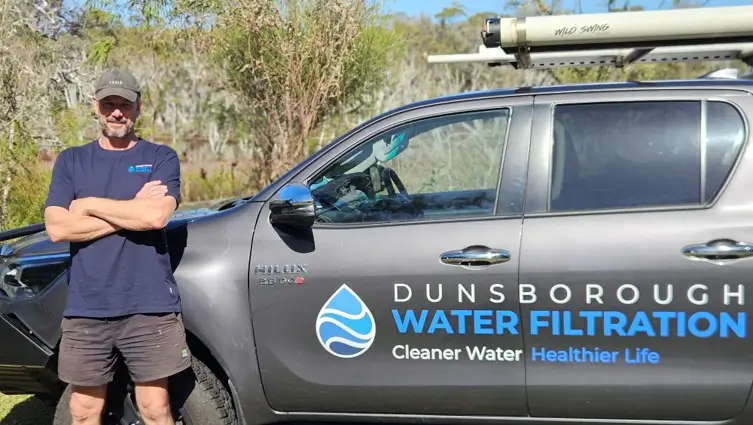
About the Author: Danny Tuffin
Danny Tuffin is the founder of Dunsborough Water Filtration and a fully licensed WA Plumbing Contractor (PL8180), authorised in Water Supply, Sanitary and Drainage Plumbing.
After building a reputation across the South West through Tuffin Plumbing & Gas for reliable service and straightforward advice, Danny launched Dunsborough Water Filtration to give local families a professional, owner-operated alternative to the big national water filter companies.
He specialises in whole-home Vortex Pro 3 installations and brings hands-on knowledge of the region’s water – from town supplies to rural bores and rainwater tanks – across Dunsborough, Busselton, Yallingup, Margaret River and surrounds.