
Few water topics have moved from obscurity to the evening news as fast as PFAS. If you’ve seen the headlines about “forever chemicals” – in rainwater, in firefighting foam, in waterways around the world – you’ve probably wondered the obvious question: is it in our water down here?
It’s a fair question, and it deserves a straight answer rather than either scaremongering or a brush-off. So here’s what PFAS actually is, what the official testing of our local supplies found, and how to think about protection at your own tap.
What is PFAS, and why does everyone suddenly care?
PFAS (per- and polyfluoroalkyl substances) is a family of thousands of manufactured chemicals used since the 1950s in things like firefighting foams, non-stick coatings, waterproofing and industrial processes. They don’t occur naturally, and their party trick is also their problem: the carbon-fluorine bonds that make them so useful are extremely hard to break down. Hence the nickname – forever chemicals.
Because they persist and accumulate, health authorities worldwide have been steadily lowering the levels considered acceptable in drinking water. Australia is no exception: in June 2025, the National Health and Medical Research Council finalised significantly tougher limits in the Australian Drinking Water Guidelines. The value for PFOS – one of the most studied PFAS compounds – dropped from a combined 70 nanograms per litre down to just 8 ng/L, with new individual limits for PFOA (200 ng/L), PFHxS (30 ng/L) and PFBS (1,000 ng/L).
A nanogram is a billionth of a gram, so these are extraordinarily small numbers. That’s the point: regulators now treat even trace PFAS as worth keeping out of drinking water.
First, a quick note on who supplies your water
It’s a common local mix-up, so it’s worth clearing up before we get to the results. Busselton, Vasse, Wonnerup and surrounds are supplied by Busselton Water, a separate state-owned utility drawing mainly from the Yarragadee aquifer. Dunsborough and Yallingup are on the Water Corporation’s Dunsborough scheme, which draws groundwater from the Quindalup wellfield about 7 km south-east of town, topped up from Butterworth Springs in summer. Busselton Water also sells bulk treated water to the Water Corporation to top up the Dunsborough supply at times, which is why the two often get confused. Each utility publishes its own annual drinking water quality report.
What testing found in the Busselton Water supply
Here’s the part that matters locally – and it’s genuinely good news.
Busselton Water introduced a dedicated PFAS sampling program in 2023-24. This wasn’t a token gesture: across the year it ran more than 1,500 individual PFAS analyses, screening over 30 different PFAS compounds in both the raw groundwater and the treated water in its network, with laboratory detection limits of 1 to 5 nanograms per litre.
The result: no PFAS detected. Not in the source water, not in the network – not one compound, in any sample, all year.
That means the Busselton supply doesn’t just meet the old guidelines; it comfortably sits below even the tough new 2025 limits. Two things help explain why. First, Busselton’s scheme water comes from the deep, confined Yarragadee aquifer – up to 800 metres underground and sealed beneath layers of rock, which shields it from the surface activities where PFAS contamination typically starts. Second, the utility is actually looking, which is more than can be said for many water sources around the country.
For Dunsborough and Yallingup, the bulk water that Busselton Water supplies to top up the scheme is that same tested water. The rest of the Dunsborough supply is reported on separately by the Water Corporation in its annual drinking water quality report, which is the document to check for the Dunsborough scheme’s own figures.
So why keep talking about it?
Because the story has a local footnote worth knowing. The same Busselton Water report notes that PFAS has been identified in the environment at several known and suspected contaminated sites in Western Australia – including one in Busselton. No PFAS was detected in the source water when the site was identified, and Busselton Water continues to liaise with the City of Busselton, the Department of Health and the Department of Water and Environmental Regulation on ongoing monitoring and testing.
To be clear: that’s the system working as it should – a contaminated site being tracked, a utility testing its water and publishing the results. It is not a reason to fear your tap. But it’s also a reminder that PFAS contamination is a real, present-day issue in our own region, not just something that happens overseas, and that clean results are something to be maintained and verified, not assumed forever.
And there’s a bigger local blind spot: all of this testing covers scheme water only. If your property runs on a rainwater tank or a private bore – as thousands across the South West do – nobody is testing your water for PFAS, or anything else. Rainwater collected from roofs has been shown in Australian studies to carry trace PFAS in some areas, and bore water quality depends entirely on what’s happened around and above your aquifer over the decades.
Where home filtration honestly fits in
We’ll give it to you straight, because that’s how we prefer to do business: if you’re on scheme water in Busselton, the current testing says you do not have a PFAS problem today, and there’s nothing in the published Dunsborough figures to suggest otherwise either.
The case for a whole-home filtration system with PFAS reduction is about the things testing can’t give you:
- A barrier, not just a report. Annual results describe last year’s water. A quality activated-carbon filtration stage at your point of entry works on whatever arrives next year, without depending on future results staying clean.
- Peace of mind at extraordinary detection levels. Guidelines are now set in nanograms. If you’d simply rather your family’s exposure be as close to zero as practical – a completely reasonable position – filtration is how you act on that at home.
- Coverage the public system can’t offer. On tank or bore water, you are the water utility. A properly specified system with the right pre-treatment is the only PFAS (and bacteria, and everything else) barrier your household has.
Both our systems are built for this: the Vortex Pro 3 for scheme-water homes includes PFAS reduction alongside chlorine, sediment and heavy-metal filtration, and the Ultra V Pro 3 adds UV sterilisation for tank and bore supplies that get no utility treatment at all.
The bottom line
PFAS is a legitimate global water issue, Australia’s new 2025 guidelines treat it seriously, and the local testing news is genuinely good: over 1,500 analyses of the Busselton Water supply in 2023-24 – the same water that tops up Dunsborough – found no PFAS at all. Credit where it’s due.
A whole-home filter isn’t about distrusting that result – it’s about not having to depend on it, year after year, for the water your family drinks. And if you’re on a tank or bore, it’s about having any barrier at all.
Want to talk it through? Call Danny on 0452 259 399 or request a quote – honest advice from a licensed WA plumbing contractor (PL8180), across Dunsborough, Busselton, Yallingup, Margaret River and surrounds.
Sources: Busselton Water, Annual Water Quality Report 2023-24 (busseltonwater.wa.gov.au), covering the Busselton Water network; Water Corporation, annual drinking water quality reporting for the Dunsborough scheme; NHMRC, updated Australian Drinking Water Guidelines for PFAS, June 2025 (nhmrc.gov.au).
Dunsborough Water Filtration supplies, installs and maintains whole-home water filtration systems across Dunsborough, Busselton, Yallingup, Margaret River and the South West. Licensed WA Plumbing Contractor PL8180.
On this page
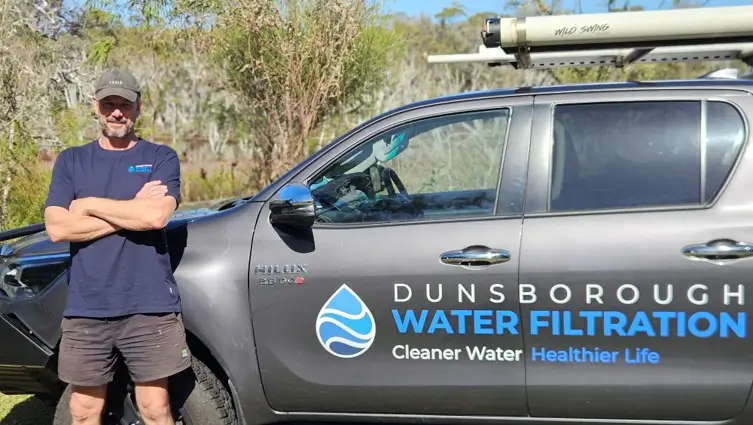
About the Author: Danny Tuffin
Danny Tuffin is the founder of Dunsborough Water Filtration and a fully licensed WA Plumbing Contractor (PL8180), authorised in Water Supply, Sanitary and Drainage Plumbing.
After building a reputation across the South West through Tuffin Plumbing & Gas for reliable service and straightforward advice, Danny launched Dunsborough Water Filtration to give local families a professional, owner-operated alternative to the big national water filter companies.
He specialises in whole-home Vortex Pro 3 installations and brings hands-on knowledge of the region’s water – from town supplies to rural bores and rainwater tanks – across Dunsborough, Busselton, Yallingup, Margaret River and surrounds.