
Pour a glass of water in Dunsborough or Busselton and you might catch it: that faint swimming-pool smell, or a sharp edge to the taste that’s more noticeable on some days than others. Maybe you smell it most in a hot shower, when the steam carries it straight to your nose.
You’re not imagining it. In its most recent Annual Water Quality Report (2023-24), Busselton Water – which supplies Busselton, Vasse, Wonnerup and surrounds – recorded 14 water quality complaints for the year. Eight of them, more than half, were about taste and odour.
Dunsborough and Yallingup are on a different supply – the Water Corporation’s Dunsborough scheme, fed by groundwater from the Quindalup wellfield and topped up at times with bulk water from Busselton Water – but the chlorine story is the same. Both utilities chlorinate their water, for the same reasons, and the Busselton Water figures below are the most detailed public window into how that plays out at the tap.
Here’s the thing, though: the chlorine behind that taste isn’t a flaw in the system. It’s there on purpose, it’s doing a genuinely important job, and the utility is open about the fact that levels sometimes exceed the taste threshold. Understanding why is the key to fixing the taste problem the right way.
Why chlorine is in our water at all
Our region’s scheme water is groundwater. Busselton’s is drawn from deep, confined aquifers – mostly the ancient Yarragadee, from 275 to more than 800 metres underground – treated at Busselton Water’s plants and then sent through 351 kilometres of pipes and five storage tanks before it reaches a home. Dunsborough’s comes from bores into the Leederville aquifer and the Sue Coal Measures about 7 km south-east of town, is treated for iron, and then makes its own journey through the Water Corporation’s pipes and tanks.
That journey is exactly why chlorine matters. Warm, still water in pipes and tanks is an environment where microorganisms can multiply, and Western Australia takes one threat particularly seriously: Naegleria fowleri, an amoeba that lives naturally in fresh, warm water. Chlorine is the barrier that keeps it, and bacteria like E. coli, out of the network.
It works. Busselton Water’s 2023-24 report shows 100 per cent microbiological compliance across 613 samples: no E. coli, no Naegleria. In fact, there has never been an E. coli detection in its distribution network since sampling began in 2010, and the last Naegleria detection anywhere in that system was back in 2011. That’s the payoff for maintaining a constant chlorine residual – and it’s why the Department of Health requires it.
How much chlorine is in the water?
Busselton Water is refreshingly transparent about this. Its operating target is a residual of 0.4 to 0.6 milligrams per litre throughout its network, and it tested chlorine levels more than 2,600 times during 2023-24 to keep it there.
The Australian Drinking Water Guidelines (ADWG) set two numbers for chlorine. The health guideline is 5 mg/L – local levels never get anywhere near it. But the aesthetic guideline, the level at which most people start to notice the taste, is just 0.6 mg/L.
And here’s the honest bit, straight from the report: Busselton Water acknowledges that the 0.6 mg/L aesthetic guideline “is exceeded on some occasions to ensure the microbiological safety of our water supply.” During 2023-24, total chlorine ranged from 0.40 mg/L at Spinnaker Boulevard up to 0.91 mg/L at Vernon Track, with a network average of 0.60 mg/L – sitting right on the taste threshold.
In other words: on an average day, the water is at the level where taste becomes noticeable, and on some days and in some streets it’s well above it. If you can taste chlorine in your water, that’s not a fault. That’s the system working exactly as designed – because when it comes to keeping pathogens out of a big public network, safety rightly beats taste every time. The Dunsborough scheme’s own chlorine results are published in the Water Corporation’s annual drinking water quality report, and the same guidelines and the same logic apply there.
Why your house might notice it more than your neighbour’s
Chlorine levels aren’t uniform across a network. They’re highest close to the treatment plants and dosing points, and gradually decline as water travels through the pipes. The time of year matters too – chlorine demand changes with temperature and with how hard the network is working, and the South West’s peak periods now push the system harder than ever (the population served roughly doubles in holiday season).
So two households a few streets apart can have quite different experiences of the same water supply. If your home happens to sit near a dosing point or on a main that runs fresh from the plant, you’ll likely be among the first to notice it.
The right way to fix the taste
Here’s the important principle: chlorine needs to be in the network – it doesn’t need to be in your glass, your kettle or your shower.
By the time water reaches your meter, the chlorine has done its job. Removing it at the point where water enters your home gives you the best of both worlds: a professionally disinfected public supply all the way to your boundary, and clean, chlorine-free water at every tap inside it.
That’s exactly what a whole-home filtration system like the Vortex Pro 3 is designed to do. Installed at the point of entry by a licensed plumber, its triple-stage filtration removes chlorine along with sediment, taste and odour compounds, heavy metals and PFAS – while leaving the natural minerals in your water. Every outlet in the house benefits:
- Drinking water that tastes like water, from any tap – no more filling jugs or buying bottles.
- Showers without the chlorine smell, which many people find noticeably gentler on skin and hair.
- Better cooking and coffee – chlorine is famously unkind to flavour, which is why cafes filter their water as a matter of course.
A filter jug on the bench can improve one jug at a time. A whole-home system fixes the kitchen tap, the fridge dispenser, the bathroom, the kids’ water bottles and the shower in one installation – and it never needs refilling.
The bottom line
Busselton Water’s chlorination program is a success story: a decade and a half without a single E. coli detection in the network is exactly what you want from a public water supplier, and the utility deserves credit for publishing its numbers so openly. The Water Corporation runs the Dunsborough scheme on the same principle.
But those same published numbers confirm what your taste buds have been telling you: the water regularly sits at – and sometimes well above – the level where chlorine becomes noticeable. The network needs that chlorine. Your home doesn’t.
Tired of the taste? We install whole-home filtration across Dunsborough, Busselton, Yallingup, Margaret River and the South West. Call Danny on 0452 259 399 or request a quote – honest advice from a licensed WA plumbing contractor (PL8180), tailored to your home.
Sources: Busselton Water, Annual Water Quality Report 2023-24 (busseltonwater.wa.gov.au), covering the Busselton Water network; Water Corporation, annual drinking water quality reporting for the Dunsborough scheme; Australian Drinking Water Guidelines (NHMRC).
Dunsborough Water Filtration supplies, installs and maintains whole-home water filtration systems across Dunsborough, Busselton, Yallingup, Margaret River and the South West. Licensed WA Plumbing Contractor PL8180.
On this page
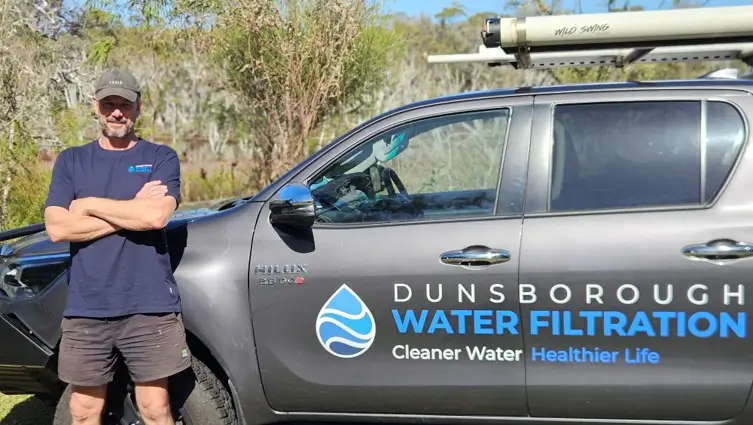
About the Author: Danny Tuffin
Danny Tuffin is the founder of Dunsborough Water Filtration and a fully licensed WA Plumbing Contractor (PL8180), authorised in Water Supply, Sanitary and Drainage Plumbing.
After building a reputation across the South West through Tuffin Plumbing & Gas for reliable service and straightforward advice, Danny launched Dunsborough Water Filtration to give local families a professional, owner-operated alternative to the big national water filter companies.
He specialises in whole-home Vortex Pro 3 installations and brings hands-on knowledge of the region’s water – from town supplies to rural bores and rainwater tanks – across Dunsborough, Busselton, Yallingup, Margaret River and surrounds.