
Most of us never think about it. Turn the tap, water comes out. But the glass of water you just poured has a genuinely remarkable back story – one that starts deep beneath the South West, in water that fell as rain long before any of us were here.
As locals who work with the region’s water every day, we think the journey is worth telling. It also happens to explain almost everything about our water’s character – why it tastes the way it does, why it’s hard, why there’s chlorine in it – better than any brochure could. So here it is, from the ground down and back up again.
The source: ancient aquifers, and two separate supplies
Busselton and Dunsborough don’t drink from dams or rivers. Both towns run on groundwater – but, in a detail that surprises many locals, not the same groundwater.
Busselton, Vasse and Wonnerup are supplied by Busselton Water, a state-owned utility that draws nearly all of its scheme water from the Yarragadee aquifer – a vast, deep formation of water-bearing sandstone that sits between roughly 275 and more than 800 metres beneath the surface, with some supply drawn from the base of the shallower Leederville aquifer above it.
Dunsborough and Yallingup are supplied by the Water Corporation’s Dunsborough water supply scheme. That water comes from the Quindalup wellfield about 7 km south-east of town, where bores tap the Leederville aquifer and the Sue Coal Measures, topped up in summer from Butterworth Springs. (Bunbury, for the record, is on a third utility again: Aqwest. And Margaret River, Cowaramup and Augusta are Water Corporation schemes of their own.)
The Yarragadee is one of Western Australia’s great natural assets. The water down there is old – it has percolated slowly through sand and rock over very long timescales – and critically, the aquifer is confined: sealed beneath layers of impermeable material that isolate it from what happens on the surface. The official source protection plan for the Busselton water reserves makes the point plainly: because of the confined nature of the source, there’s very little risk of contamination from overlying land uses. It’s about as protected as a drinking water source can be.
That deep, slow journey is also where our water picks up its personality, in both towns. Long contact with minerals gives it hardness (calcium and magnesium), iron and manganese, natural fluoride, and its overall mineral character. Nothing sinister – just geology, dissolved.
The lift: eight bores (and a wellfield)
Getting Busselton’s water up from those depths is the job of eight production bores, operated by Busselton Water under groundwater licences from the Department of Water and Environmental Regulation. Extraction is governed by an annually reviewed operating strategy, with consultant hydrogeologists monitoring sustainability – because an aquifer, however vast, is a savings account you draw on carefully. In 2023-24, 7.21 gigalitres were drawn – that’s over seven billion litres, or roughly 2,900 Olympic pools, hauled up from the deep in a single year.
In Dunsborough, the Water Corporation’s Quindalup bores do the same job on a smaller scale, feeding a scheme sized for a town that swells every summer.
The treatment: air, sand and chlorine
Raw Yarragadee water isn’t drinkable as it comes out of the ground – it carries too much dissolved iron and manganese (iron up to 11 mg/L in 2023-24, nearly 40 times the drinking guideline). So Busselton Water passes it through three treatment plants, where a three-step process cleans it up:
- Pre-oxidation and aeration. A small dose of chlorine and a cascade through spray aerators oxidise the dissolved iron and manganese, turning them from invisible dissolved metals into tiny solid particles.
- Sand filtration. The water then percolates through sand filters, which strain out those particles along with turbidity and other impurities. (Worth pausing on: filtration is literally how our water is made drinkable. It’s the same principle a home system applies – just at municipal scale, and at a coarser finish.)
- Disinfection. A final chlorine dose protects the water on the journey ahead, maintaining a residual of at least 0.4 mg/L throughout the network to guard against bacteria and the amoeba Naegleria – the reason WA utilities take chlorination so seriously.
Dunsborough’s groundwater has the same iron problem and gets the same kind of answer: the Water Corporation treats it for iron before it enters the network (treated-water iron averaged just 0.006 mg/L in 2024-25) and chlorinates it for the journey through the mains.
One more local quirk gets settled at this stage, and it’s different in each town. Busselton Water adds no fluoride. Its water carries a modest natural dose (averaging 0.4 mg/L) from the aquifer itself. Dunsborough has the opposite situation: the Quindalup groundwater naturally contains more fluoride than the target, so the Water Corporation partially removes it – de-fluoridating the water from the Sue aquifer bores to land around 0.7 to 1.0 mg/L. So in neither town is fluoride added; in Dunsborough it’s natural and adjusted down. (Bunbury, by contrast, is fluoridated in the conventional way.)
The delivery: tanks, mains and a doubling population
From Busselton Water’s plants, treated water flows into five storage tanks and out through 351 kilometres of mains to more than 15,000 connections, serving over 30,000 people. And here’s the detail behind a common local mix-up: Busselton Water also sells bulk treated water to the Water Corporation to top up the Dunsborough supply at times. That’s why plenty of Dunsborough residents assume they’re on Busselton’s water. Day to day they aren’t – Dunsborough runs on its own Quindalup supply through the Water Corporation’s network – but when the top-up is flowing, a share of Busselton’s story reaches Dunsborough taps too.
The Busselton network’s remarkable challenge is its elasticity. In peak holiday periods, the population served roughly doubles to more than 60,000. Same bores, same plants, same pipes – twice the people. It’s a testament to the system that quality holds up; it also explains why summer is when the water’s character moves around most, with chlorine dosing working hardest and dissolved solids at their peak (the only aesthetic exceedances in 2023-24 were two TDS readings in the January school holidays). Dunsborough’s scheme faces the same seasonal swing.
Along the way, a multi-barrier approach guards the supply: protection of the groundwater source, treatment, the chlorine residual, and backflow prevention – including innovative radio-frequency water meters that detect backflow from residential properties. Busselton Water’s 2023-24 scorecard for all of this: 100 per cent health compliance, zero reportable incidents.
The last few metres: your place
And then the journey ends – at your meter. Everything past that point is yours: your pipes, your hot water system, your taps, your call.
Here’s the honest way to think about it. The utility’s job is to deliver safe water to thousands of connections, and both utilities do that job well. But some of what makes the journey possible arrives at your boundary as a trade-off: the chlorine that protected the water through hundreds of kilometres of mains is still in it at your kitchen tap, sitting right at the taste threshold. The hardness picked up over centuries underground is on its way to your hot water element. The occasional stirred-up iron sediment from a mains repair is headed for your washing machine.
None of that needs fixing for the network. All of it can be finished to a higher standard for one particular house – yours. That’s what a whole-home system like the Vortex Pro 3 does: one final, finer stage of the same journey, installed at the point where the public system’s job ends and your home begins. The water arrives safe; it enters your house finished – chlorine-free, sediment-free, scale-controlled, with the natural minerals still in.
Eight hundred metres of geology, eight bores (or the Quindalup wellfield, if you’re in Dunsborough), treatment plants, storage tanks, hundreds of kilometres of pipe… and then the last few metres are up to you.
Want your water finished properly? Call Danny on 0452 259 399 or request a quote – honest advice from a licensed WA plumbing contractor (PL8180), across Dunsborough, Busselton, Yallingup, Margaret River and surrounds.
Sources: Busselton Water, Annual Water Quality Report 2023-24 (busseltonwater.wa.gov.au); Busselton Water Reserves Drinking Water Source Protection Plan (WRP 139); Water Corporation, Drinking Water Quality Annual Report 2024-25, Dunsborough scheme (watercorporation.com.au).
Dunsborough Water Filtration supplies, installs and maintains whole-home water filtration systems across Dunsborough, Busselton, Yallingup, Margaret River and the South West. Licensed WA Plumbing Contractor PL8180.
On this page
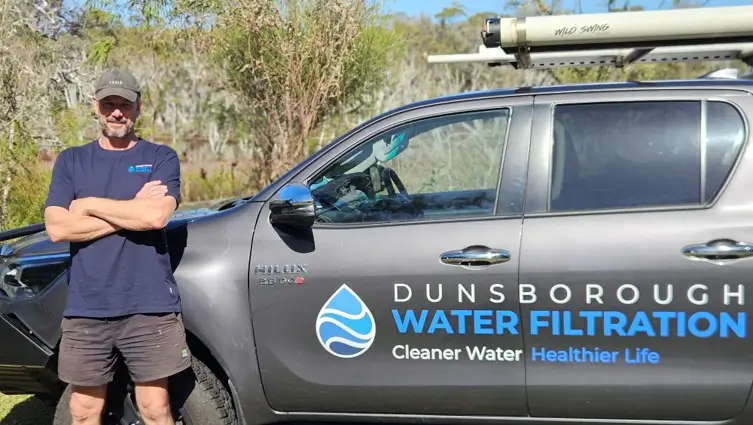
About the Author: Danny Tuffin
Danny Tuffin is the founder of Dunsborough Water Filtration and a fully licensed WA Plumbing Contractor (PL8180), authorised in Water Supply, Sanitary and Drainage Plumbing.
After building a reputation across the South West through Tuffin Plumbing & Gas for reliable service and straightforward advice, Danny launched Dunsborough Water Filtration to give local families a professional, owner-operated alternative to the big national water filter companies.
He specialises in whole-home Vortex Pro 3 installations and brings hands-on knowledge of the region’s water – from town supplies to rural bores and rainwater tanks – across Dunsborough, Busselton, Yallingup, Margaret River and surrounds.