
Did you know that every year, a detailed 30-page report is published telling you exactly what’s in your tap water?
Busselton Water’s Annual Water Quality Report covers everything from bacteria to pesticides to radioactivity, in tables that run to hundreds of individual test parameters. It’s publicly available on their website. The Water Corporation publishes an equivalent annual drinking water quality report for its schemes, including Dunsborough. They’re also, let’s be honest, not exactly bedtime reading.
We work with the region’s water every day, so we read Busselton Water’s 2023-24 report cover to cover, and checked the Water Corporation’s 2024-25 figures for Dunsborough alongside it. Here’s what they say – translated into plain English, with the numbers that actually matter for your home highlighted along the way.
First: who supplies your water?
If you live in Busselton, Vasse, Wonnerup or surrounds, your water comes from Busselton Water, a state-owned water corporation that’s been operating since 1906. It serves more than 30,000 people – a number that more than doubles to 60,000+ in peak holiday periods. Busselton Water’s annual report describes this network, and this network only.
If you live in Dunsborough or Yallingup, your water comes from the Water Corporation’s Dunsborough water supply scheme: groundwater from the Quindalup wellfield about 7 km south-east of town, treated for iron before it enters the network. The figures that apply to your taps are in the Water Corporation’s annual drinking water quality report. One detail that confuses a lot of locals: Busselton Water does sell bulk water to the Water Corporation to top up the Dunsborough supply at times, which is why people often assume Dunsborough is on Busselton’s water. It isn’t – so where the Dunsborough numbers differ from Busselton’s, we’ve noted them below.
(On a rainwater tank or bore? Neither report covers your water at all – more on that at the end.)
Where the water comes from
Our scheme water doesn’t come from dams or rivers. Busselton’s is groundwater, drawn by eight production bores from the Yarragadee aquifer – an ancient, confined formation that sits between 275 and more than 800 metres underground – with some draw from the shallower Leederville aquifer. Dunsborough’s is groundwater too, from bores at Quindalup into the Leederville aquifer and the Sue Coal Measures, topped up in summer from Butterworth Springs.
Because the Yarragadee is so deep and sealed off by layers of rock, the source itself is well protected from surface contamination. But raw groundwater from these aquifers isn’t drinkable as-is: it carries naturally occurring iron, manganese, colour and turbidity. Busselton Water’s raw water data shows iron as high as 11 mg/L before treatment – more than 35 times the aesthetic guideline for drinking water.
So Busselton Water treats it in three steps at its three treatment plants: a small dose of chlorine plus aeration to oxidise the iron and manganese into solids, sand filtration to remove them, and a final chlorine dose to disinfect the water before it’s stored and piped to homes. The Water Corporation likewise treats the Dunsborough supply for iron before it enters the network, and chlorinates it.
It’s worth pausing on that middle step: the water you drink has already been through filtration – it’s literally how groundwater is made drinkable. A home filtration system is simply a finer, final stage of the same process, at your own boundary.
What gets tested – and what the results were
The scale of testing in Busselton Water’s report is impressive. During 2023-24:
- 613 microbiological samples were tested for E. coli and Naegleria. Result: 100% compliant – zero detections. There has never been an E. coli detection in the distribution network since sampling began in 2010.
- 1,287 chemical health samples covered metals and other health parameters – arsenic, lead, mercury, cadmium, uranium and more. Result: 100% compliant. Most were simply not detected at all.
- 450 pesticide and herbicide analyses screened for dozens of agricultural chemicals. Result: not a single detection.
- PFAS (“forever chemicals”) got their own new sampling program, introduced in 2023-24, covering more than 30 individual PFAS compounds in both raw and treated water. Result: none detected. (This topic deserves its own article – see our PFAS explainer.)
- Radiological testing (gross alpha and beta) came back 100% compliant.
- More than 2,600 chlorine tests kept disinfection on target across the network.
The headline: zero incidents reportable to the Department of Health, 100% health compliance across the board, and 99.9% compliance on aesthetic (non-health) measures. By any fair reading, that’s an excellent result, delivered in a year the report notes was one of record demand and above-average summer temperatures. The Water Corporation’s Dunsborough figures for 2024-25 tell a similarly clean story on the basics: colour below 1 TCU, turbidity below 0.2 NTU, and iron averaging just 0.006 mg/L after treatment.
The fine print worth knowing
So the water is safe – genuinely. But “safe” and “exactly how you’d like it” aren’t the same thing, and the reports are equally honest about the details most relevant to your home:
Chlorine sits at the taste threshold. The taste guideline for chlorine is 0.6 mg/L. Busselton Water’s network averaged 0.60 mg/L in 2023-24 and peaked at 0.91 mg/L, because the utility – quite rightly – prioritises disinfection over taste. It’s no coincidence that 8 of the 14 customer complaints for the year were about taste and odour. The Water Corporation chlorinates the Dunsborough supply too.
The water is hard in Busselton, moderately hard in Dunsborough. Hardness reached 150 mg/L (as calcium carbonate) in Busselton Water’s network – within guidelines, but firmly in the territory where scale builds up on hot water systems, appliances and shower screens. Dunsborough’s supply measured 74 to 88 mg/L (mean 81) in 2024-25: moderately hard, and noticeably softer than Busselton’s, though still enough to leave its mark on a hot water element over time.
Total dissolved solids can spike. The only aesthetic exceedances of Busselton Water’s year were two TDS results in January 2024 – 640 mg/L at Vernon Track and 630 mg/L at Orlando Boulevard, just over the 600 mg/L “good quality” threshold. Short-lived, not a health issue, but a reminder that water character shifts with peak summer demand. Dunsborough’s TDS ranged from 443 to 658 mg/L (mean 542) in 2024-25, with a pH of about 8.4.
Discoloured water happens occasionally. The other 6 complaints to Busselton Water were about discolouration – typically iron sediment stirred up by disturbances in the mains, fixed by flushing. Harmless, but nobody enjoys brown water in a white laundry.
There’s fluoride, but nobody’s adding it. A genuine local quirk, and it works differently in each town. Busselton Water does not add fluoride: the fluoride in its supply occurs naturally in the aquifer, varying from 0.1 to 1.0 mg/L depending on the bore, and averaging 0.4 mg/L – well under the 1.5 mg/L guideline. Dunsborough’s groundwater naturally contains more fluoride than the target, so the Water Corporation partially removes it, de-fluoridating water from the Sue aquifer bores to land around 0.7 to 1.0 mg/L. Natural in both towns; adjusted down in Dunsborough; added in neither.
And if you’re on a tank or bore?
Everything above applies to scheme water only. The 613 bacteriological samples, the pesticide screens, the PFAS program – none of it covers rainwater tanks or private bores. If that’s your supply, the testing regime is entirely up to you, and in our experience most rural properties have never had their water professionally tested. We’d genuinely encourage it – it’s the starting point for knowing your water is safe. We test the standard water quality parameters across the South West, and for bacteria testing we’ll point you to an accredited laboratory.
What this means for your home
Our honest take, as locals who read these reports so you don’t have to: Busselton Water and the Water Corporation both do their job well, and the results prove it. The role of home filtration here isn’t to rescue an unsafe supply – it’s to finish the job to your standard: taking out the chlorine once it’s done its work, stopping scale before it reaches your hot water system, catching sediment from mains disturbances, and adding a final barrier at your boundary for the things you’d rather not think about.
Want to know what’s in the water at your place? We test water across the South West every week – town, tank and bore. Call Danny on 0452 259 399 or request a quote – honest advice from a licensed WA plumbing contractor (PL8180).
Sources: Busselton Water, Annual Water Quality Report 2023-24 (busseltonwater.wa.gov.au); Water Corporation, Drinking Water Quality Annual Report 2024-25, Dunsborough scheme (watercorporation.com.au); Australian Drinking Water Guidelines (NHMRC).
Dunsborough Water Filtration supplies, installs and maintains whole-home water filtration systems across Dunsborough, Busselton, Yallingup, Margaret River and the South West. Licensed WA Plumbing Contractor PL8180.
On this page
About the Author: Danny Tuffin
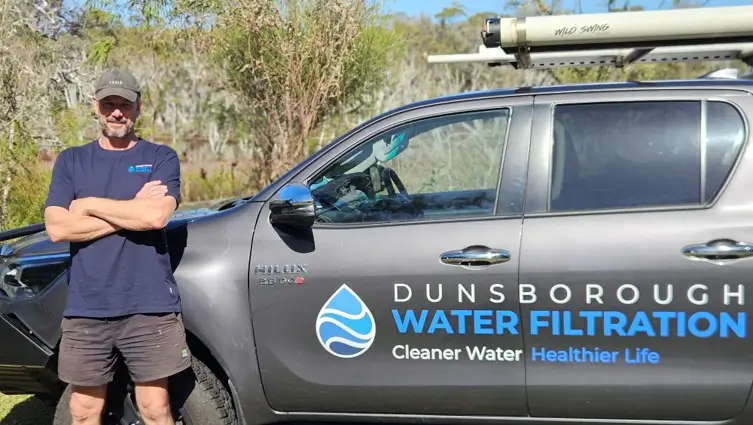
Danny Tuffin is the founder of Dunsborough Water Filtration and a fully licensed WA Plumbing Contractor (PL8180), authorised in Water Supply, Sanitary and Drainage Plumbing.
After building a reputation across the South West through Tuffin Plumbing & Gas for reliable service and straightforward advice, Danny launched Dunsborough Water Filtration to give local families a professional, owner-operated alternative to the big national water filter companies.
He specialises in whole-home Vortex Pro 3 installations and brings hands-on knowledge of the region’s water – from town supplies to rural bores and rainwater tanks – across Dunsborough, Busselton, Yallingup, Margaret River and surrounds.