
Here’s a question worth sitting with for a moment: when was your drinking water last tested?
If you’re on scheme water in Busselton or Dunsborough, the answer is probably “this week.” Busselton Water – the state-owned utility that supplies Busselton, Vasse, Wonnerup and surrounds – runs one of the more rigorous testing regimes you’ll find anywhere, overseen by a formal agreement with the Department of Health. Dunsborough and Yallingup are on a separate supply, the Water Corporation’s Dunsborough scheme, which draws groundwater from the Quindalup wellfield south-east of town; it is tested and reported under the same Department of Health oversight, with its own annual drinking water quality report. (Busselton Water does sell bulk water to top up the Dunsborough supply at times, which is why the two are often confused.)
If your home runs on a rainwater tank or a private bore – as thousands of properties across the South West do, from Yallingup to Cowaramup to the blocks out the back of Margaret River – the answer is very likely “never.”
That gap is worth understanding, because it’s not a small one.
What the town supply gets checked for
Busselton Water’s most recent Annual Water Quality Report (2023-24) sets out the full program for its network, and the scale of it is genuinely impressive:
- 613 microbiological samples across the year, testing for E. coli and Naegleria – the pathogens that cause serious waterborne illness. All clear.
- More than 2,600 chlorine tests to make sure disinfection never lapses anywhere in the network.
- 1,287 chemical health samples covering arsenic, lead, mercury, cadmium, uranium and a long list of other health parameters.
- 450 pesticide and herbicide analyses, screening for dozens of agricultural chemicals. Not one detection.
- A dedicated PFAS program – more than 1,500 analyses across 30+ “forever chemical” compounds. None detected.
- Radiological testing for naturally occurring radioactivity in groundwater.
Behind all that sits a licensed utility with three treatment plants, trained water quality staff, incident response plans that get rehearsed with the Department of Health, and quarterly compliance reports to the regulator. When something drifts even slightly – like two total dissolved solids readings in January 2024 – it’s documented, reported and followed up. The Water Corporation runs the Dunsborough scheme to the same standards.
That’s what it takes to stand behind a supply of drinking water. Now compare it with what’s watching over your tank or bore.
What your tank or bore gets checked for
Nothing. Unless you arrange it, no agency tests private rainwater tanks or bores in Western Australia. There’s no annual report for your roof catchment, no health department oversight of your aquifer, no one flushing your lines or checking your first-flush diverter. You are, in every practical sense, your own water utility – responsible for source, treatment and testing, usually with none of the tools the professionals use.
And the risks aren’t hypothetical. They’re just different for each supply:
Rainwater tanks start with the cleanest source imaginable and then run it across your roof. Bird and possum droppings, dead insects and small animals, leaf litter breaking down in gutters, dust and ash – all of it can end up in the tank, which is why health authorities consistently note that untreated tank water can carry bacteria like E. coli. Tanks that look and taste fine can still fail a bacteriological test; the contamination that matters is invisible. In fact, Australian research has found E. coli in around half of tested tank water samples, as we explain in our article on E. coli in rainwater tanks.
Private bores tap the same kinds of aquifers the utilities use – but without the treatment. And here the town supply’s own data is revealing: Busselton Water’s report shows what its raw groundwater looks like before treatment – iron up to 11 mg/L (nearly 40 times the drinking water guideline), colour at 52 Hazen units, total dissolved solids up to 980 mg/L. The utility fixes that with aeration, oxidation and sand filtration before anyone drinks it, and the Water Corporation likewise treats the Dunsborough bores for iron before the water enters the network. A private bore drawing from shallower, less protected groundwater gets no such treatment – and shallow aquifers are far more exposed to decades of surrounding land use than the deep, confined aquifers the utilities draw from (the Yarragadee under Busselton, and the Leederville and Sue Coal Measures bores at the Quindalup wellfield that supply Dunsborough). Bore quality in this region genuinely varies paddock to paddock: iron staining, hardness, salinity, and in some areas nitrates or bacteria.
The good news: this is a solvable problem
None of this means tank and bore water can’t be excellent. It often is – some of the best-tasting water in the region comes off a well-kept roof. It means the two things the town supply has, and your supply doesn’t, need to be put in place at your property: testing and a treatment barrier.
Step one is always a proper water test. Not guesswork, not “it’s always been fine” – an actual analysis of what’s in your water. It’s the only way to know whether you’re dealing with iron, hardness, salinity, or nothing much at all, and it’s what any honest recommendation has to be built on. We test tank, bore and scheme water across the South West every week for the standard water quality parameters. For bacteria such as E. coli, we recommend sending a sample to an accredited laboratory – it’s the only way to get a reliable answer, and we can point you to one.
Step two is a barrier matched to your water. For tank and bore supplies, that’s what the Ultra V Pro 3 was built for: multi-stage filtration to deal with sediment, taste, odour and chemical contaminants, plus UV sterilisation as the final stage – the same disinfection principle used by water utilities, neutralising bacteria and other microorganisms without adding any chlorine to your water. A stainless steel cover, a 10-year warranty, and sized and configured for your actual water, not a one-size-fits-all box.
That last point matters more on rural properties than anywhere else. Because bore and tank chemistry varies so much, the right system depends on the test results – sometimes extra pre-treatment earns its keep, sometimes it isn’t needed at all. That’s exactly the kind of call you want a licensed local plumber making, not a mail-order checkout page.
The bottom line
Town water in our region earns its safety the hard way: thousands of tests a year, professional treatment, and a regulator looking over the utility’s shoulder. If you’re on a tank or bore, none of that infrastructure exists for you – until you build it yourself. The first step costs little and tells you everything: get the water tested.
On tank or bore water and never had it tested? Call Danny on 0452 259 399 or request a quote – water testing and honest advice from a licensed WA plumbing contractor (PL8180), across Dunsborough, Busselton, Yallingup, Margaret River and surrounds.
Sources: Busselton Water, Annual Water Quality Report 2023-24 (busseltonwater.wa.gov.au); Water Corporation, Annual Drinking Water Quality Report (Dunsborough scheme); Australian Drinking Water Guidelines (NHMRC).
Dunsborough Water Filtration supplies, installs and maintains whole-home water filtration systems across Dunsborough, Busselton, Yallingup, Margaret River and the South West. Licensed WA Plumbing Contractor PL8180.
On this page
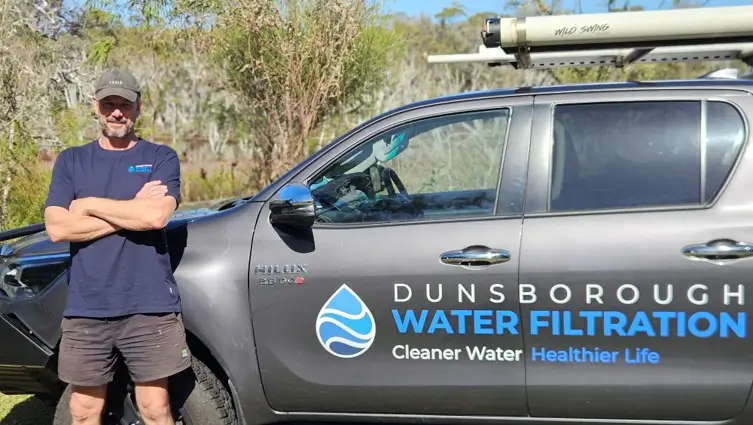
About the Author: Danny Tuffin
Danny Tuffin is the founder of Dunsborough Water Filtration and a fully licensed WA Plumbing Contractor (PL8180), authorised in Water Supply, Sanitary and Drainage Plumbing.
After building a reputation across the South West through Tuffin Plumbing & Gas for reliable service and straightforward advice, Danny launched Dunsborough Water Filtration to give local families a professional, owner-operated alternative to the big national water filter companies.
He specialises in whole-home Vortex Pro 3 installations and brings hands-on knowledge of the region’s water – from town supplies to rural bores and rainwater tanks – across Dunsborough, Busselton, Yallingup, Margaret River and surrounds.