
Fluoride in drinking water is one of those topics people tend to have firm opinions about – for it, against it, or just quietly curious about what’s actually coming out of their own tap.
Whatever your view, you deserve accurate local facts to base it on. And the local facts here are genuinely surprising: our water doesn’t follow the standard Australian script at all.
The short answer
Yes, there is fluoride in Busselton and Dunsborough scheme water. But – and here’s the part most locals don’t know – nobody is adding it. The fluoride in both supplies is naturally occurring, dissolved into the groundwater during its long residence in the deep aquifers our region drinks from.
That makes our area unusual. Across most of Western Australia, fluoride is deliberately dosed into drinking water at treatment plants as a public dental health measure, typically targeting somewhere around 0.6 to 0.8 milligrams per litre depending on climate. Here, the local geology simply delivers a dose of its own – no dosing plant required. In Dunsborough’s case, the geology is actually a little too generous, and the utility takes some fluoride out. More on that below.
One thing to get straight first, because it trips up a lot of locals: Busselton and Dunsborough are on two different water supplies. Busselton, Vasse, Wonnerup and surrounds are supplied by Busselton Water, drawing mainly from the Yarragadee aquifer. Dunsborough and Yallingup are supplied by the Water Corporation’s Dunsborough scheme, which draws groundwater from the Quindalup wellfield about 7 km south-east of town. (Busselton Water does sell bulk water to top up the Dunsborough supply at times, which is where the confusion comes from.) The two utilities publish separate annual water quality reports, so the numbers below are given separately too.
How much fluoride is in Busselton’s water?
Busselton Water states plainly in its Annual Water Quality Report that it does not add fluoride. Its 2023-24 report gives precise numbers for its network, from 162 samples across raw and treated water:
- The natural levels vary from bore to bore, ranging between 0.1 and 1.0 milligrams per litre depending on where and when the water was drawn.
- The network average was 0.4 mg/L for the reporting period.
- The health guideline is 1.5 mg/L under the Australian Drinking Water Guidelines – so even the highest readings sit well inside it, and compliance was 100 per cent.
Two things are worth noting about those numbers. First, the average of 0.4 mg/L is actually a touch below the level most fluoridated Australian supplies aim for – so if you moved to Busselton from Perth, you’re likely drinking slightly less fluoride than you were, not more. Second, the variation is real: because different bores contribute differently over time, the level at your tap isn’t a fixed number but a range.
How much fluoride is in Dunsborough’s water?
Dunsborough’s story runs the other way. The groundwater feeding the Dunsborough scheme naturally contains more fluoride than the public health target, so the Water Corporation partially removes it, treating the water from the higher-fluoride bores to bring the supply down to around 0.7 to 1.0 mg/L, with an optimum of just under 0.9 mg/L. That still sits comfortably under the 1.5 mg/L health guideline, and roughly in line with what a conventionally fluoridated supply would aim for. The difference is that in Dunsborough the fluoride is natural and adjusted down, not added. The scheme’s results are published in the Water Corporation’s annual drinking water quality report.
Why is there fluoride in groundwater at all?
Fluoride is a naturally occurring mineral, released as water slowly dissolves fluoride-bearing rocks and sediments. Our region’s scheme water spends a very long time underground – Busselton’s comes from the Yarragadee aquifer, up to 800 metres down, and Dunsborough’s from bores into the Leederville aquifer and the Sue Coal Measures at the Quindalup wellfield – which gives it plenty of contact time with the geology. The same long underground journey that gives our water its iron, hardness and mineral character gives it a measure of natural fluoride too.
This isn’t unusual for deep groundwater around the world; what’s less common is a town supply where the natural level happens to land in roughly the range public health authorities would choose anyway (Busselton), or just above it (Dunsborough). It’s a quirk of geological luck.
What about tank and bore water?
The picture flips completely outside the scheme network:
- Rainwater tanks contain essentially no fluoride. Rain doesn’t pick up minerals until it touches the ground, so tank-water households – including kids – get little to no fluoride from their drinking water. That’s worth knowing when you talk to your dentist, who may factor it into advice about toothpaste and dental care.
- Private bores are a wildcard. A bore taps groundwater, so it may well carry natural fluoride – but the level depends entirely on your local geology and could be lower or higher than the town supply. The only way to know is to test, which is true of everything else in bore water too.
Can fluoride be removed, if I’d rather not drink it?
Here’s where we’ll be straight with you, because it’s an area with a lot of loose marketing claims: standard carbon-based filtration – including most whole-home systems – is not designed to remove fluoride. Fluoride is a small, highly stable dissolved ion. Some whole-home cartridges do knock it back: the HydroFlow kit we fit in the Vortex Pro 3 reduces fluoride when the cartridge is new, but that capacity fades well before the 12 month cartridge change, so we don’t sell it as a fluoride solution. The only reliable way to take fluoride out of drinking water is reverse osmosis at the kitchen tap.
So if reducing fluoride matters to you, the honest path is: test your water so you know your actual starting level – at an average of 0.4 mg/L in Busselton, many people are surprised how low it already is – and then, if you still want it lower, fit the right tool for that specific job, a point-of-use reverse osmosis unit for drinking water, alongside whatever whole-home filtration handles chlorine, sediment, scale and the rest. We can supply RO units, and we’re happy to advise on both, and to tell you plainly when something isn’t needed.
The bottom line
Our region’s fluoride story is a local curiosity: two neighbouring town supplies with natural fluoride, in a state that normally has to dose it. In Busselton the levels are modest – averaging 0.4 mg/L, well under the 1.5 mg/L guideline – and they vary with the bores supplying your area. In Dunsborough the groundwater carries a little more than the target, so the Water Corporation adjusts it down to around 0.9 mg/L. Neither utility adds fluoride. Tank households get essentially none; bore households need a test to know.
Whatever you decide about fluoride, decide it with real numbers from your own tap.
Want to know what’s actually in your water? We test scheme, tank and bore water across the South West every week. Call Danny on 0452 259 399 or request a quote – honest advice from a licensed WA plumbing contractor (PL8180), across Dunsborough, Busselton, Yallingup, Margaret River and surrounds.
Sources: Busselton Water, Annual Water Quality Report 2023-24 (busseltonwater.wa.gov.au), covering the Busselton Water network; Water Corporation, annual drinking water quality reporting for the Dunsborough scheme; Australian Drinking Water Guidelines (NHMRC).
Dunsborough Water Filtration supplies, installs and maintains whole-home water filtration systems across Dunsborough, Busselton, Yallingup, Margaret River and the South West. Licensed WA Plumbing Contractor PL8180.
On this page
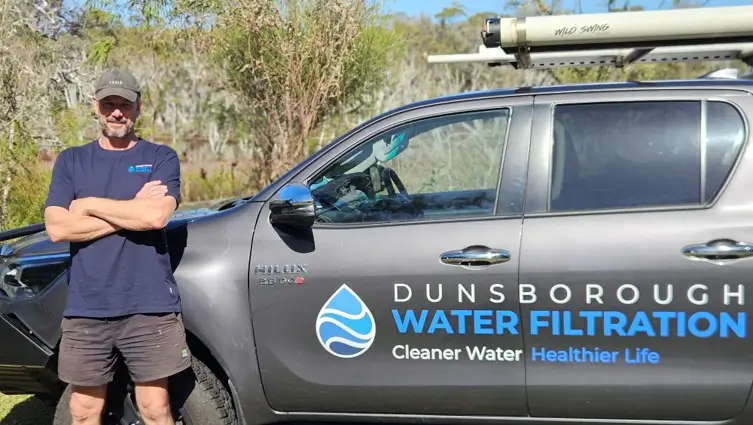
About the Author: Danny Tuffin
Danny Tuffin is the founder of Dunsborough Water Filtration and a fully licensed WA Plumbing Contractor (PL8180), authorised in Water Supply, Sanitary and Drainage Plumbing.
After building a reputation across the South West through Tuffin Plumbing & Gas for reliable service and straightforward advice, Danny launched Dunsborough Water Filtration to give local families a professional, owner-operated alternative to the big national water filter companies.
He specialises in whole-home Vortex Pro 3 installations and brings hands-on knowledge of the region’s water – from town supplies to rural bores and rainwater tanks – across Dunsborough, Busselton, Yallingup, Margaret River and surrounds.