
Every so often a customer asks us, half-joking: “Is the water here actually hard, or do I just need to clean my shower screen more often?”
Fair question – and thanks to the utilities’ annual water quality reports, it has an official answer. Busselton Water publishes detailed figures every year for the network that serves Busselton, Vasse and Wonnerup, and the Water Corporation does the same for its Dunsborough scheme, which supplies Dunsborough and Yallingup from the Quindalup wellfield south-east of town. We’ve been through the latest editions of both. Here’s what the numbers say about hardness in each town, why your appliances care, and what the sensible fix looks like.
The headline numbers
Busselton: up to 150 mg/L. Water hardness – the measure of dissolved calcium and magnesium – reached 150 milligrams per litre (as calcium carbonate) in Busselton Water’s distribution network during 2023-24. On the standard classification scale, anything from 60 to 120 is “moderately hard” and 120 to 180 is “hard”. Busselton’s supply sits in the hard band at its peaks – and notably, this is a step up from the roughly 140 mg/L reported previously. The guideline value is 200 mg/L, so it’s fully compliant – but the guideline exists because beyond it “excessive scale” forms. At 150, scale doesn’t wait for permission.
Dunsborough: 74 to 88 mg/L. Dunsborough is on a different supply. The Water Corporation’s Dunsborough scheme draws groundwater from the Quindalup wellfield, and its 2024-25 figures put hardness at 74 to 88 mg/L as calcium carbonate (mean 81) – moderately hard, and noticeably softer than Busselton’s. Total dissolved solids ran from 443 to 658 mg/L (mean 542). Busselton Water does sell bulk water to the Water Corporation to top up the Dunsborough supply at times, which is one reason locals often assume the two towns share the same water. They don’t: Dunsborough’s water sits a full band below Busselton’s for hardness.
Total dissolved solids: spiking in summer. In Busselton’s network, TDS – the total load of dissolved minerals and salts – produced the only aesthetic guideline exceedances of the entire year. On 16 January 2024, at the height of the holiday season, samples reached 640 mg/L at Vernon Track and 630 mg/L at Orlando Boulevard, nudging past the 600 mg/L threshold below which water is classified as “good quality”. Short-lived, not a health concern, and openly reported – but a useful data point: when the network runs hardest, the mineral load runs highest. And it can’t hurt to remember that Busselton’s raw groundwater measures up to 980 mg/L before blending and treatment.
Why our water is like this. It’s simple geology. Scheme water in both towns is drawn from deep aquifers – Busselton’s mostly from the Yarragadee, hundreds of metres down; Dunsborough’s from the Leederville aquifer and the Sue Coal Measures beneath Quindalup – where water has spent a very long time in contact with mineral-bearing rock. Groundwater supplies are almost always harder than dam or rainfall supplies; it comes with the territory, and no amount of utility treatment changes it, because calcium and magnesium aren’t contaminants to be removed. They’re natural minerals – and in your drinking water, they’re actually welcome.
Where hardness hits your household budget
Hard water isn’t a health problem. Calcium and magnesium are minerals your body uses. The cost shows up in your house instead, because when hard water is heated or evaporates, those minerals come out of solution and cement themselves onto surfaces as limescale:
- Hot water systems take the biggest hit. Scale coats elements and heat exchangers, making the system work harder, use more energy and die younger. Replacing a hot water service years early is the single most expensive consequence of hard water – and at Busselton’s 150 mg/L, it’s a when, not an if.
- Appliances – dishwashers, washing machines, coffee machines and kettles all scale up, clog and wear out ahead of schedule.
- Fixtures and glass – the crusty tap aerators, spotted shower screens and stubborn white film you keep cleaning off are hardness minerals left behind by evaporation.
- Soap and detergent – hard water fights lather, so everything from shampoo to laundry powder works worse and gets used faster.
None of it is dramatic. All of it is cumulative – which is why the summer TDS spikes are worth noting too. Higher dissolved mineral loads through the hottest months land exactly when your hot water system, holiday-house appliances and pool-adjacent outdoor fixtures are working their hardest.
What the numbers don’t say: get a softener
Here’s where we’ll be honest, because plenty of companies would use the figures above to sell you a salt-based water softener. At 150 mg/L in Busselton, let alone 74 to 88 mg/L in Dunsborough, our scheme water does not need one – and softeners bring baggage: bags of salt, brine discharge to the environment, wasted water from backwashing, added sodium in every glass, and the stripped-out, “slippery” water that many people dislike.
There’s a better-suited approach for our water: keep the minerals, stop the scale. Modern salt-free scale control (the DAC anti-scale media in our DuraScale-X™ filter pack) converts hardness minerals into stable micro-crystals that stay suspended in the water instead of bonding to your hot water element, pipes and shower screen. No salt, no brine, no wasted water, no power – and your drinking water keeps its natural minerals and taste. We’ve written a full guide to how it works: Water Softening Without a Water Softener.
Fitted as the third stage of a Vortex Pro 3 whole-home system, the same installation also handles what a softener never touches – the chlorine that sits at the taste threshold in our network, sediment from mains disturbances, heavy metals and PFAS. One compact unit with a stainless steel finish at your point of entry, a 10-year warranty, and every tap and appliance in the house protected.
And if you’re on a bore, the town numbers are your floor, not your ceiling – private bores in this region regularly test harder than the scheme supply, sometimes much harder. A water test tells you exactly where your property sits, and the treatment gets specified to match.
The bottom line
The official data confirms what your kettle already knew: our water is hard – up to 150 mg/L in Busselton and trending up, moderately hard at 74 to 88 mg/L in Dunsborough, with mineral loads peaking through the summer months when your appliances work hardest. It’s nothing to worry about health-wise, and nothing that needs a salt-guzzling softener. It’s a maintenance problem – and like most maintenance problems, far cheaper to prevent than to keep paying for.
Want to know exactly how hard your water is? We test water across the South West every week – scheme, bore and tank. Call Danny on 0452 259 399 or request a quote – honest advice from a licensed WA plumbing contractor (PL8180).
Sources: Busselton Water, Annual Water Quality Report 2023-24 (busseltonwater.wa.gov.au); Water Corporation, Drinking Water Quality Annual Report 2024-25, Dunsborough scheme (watercorporation.com.au); Australian Drinking Water Guidelines (NHMRC).
Dunsborough Water Filtration supplies, installs and maintains whole-home water filtration systems across Dunsborough, Busselton, Yallingup, Margaret River and the South West. Licensed WA Plumbing Contractor PL8180.
On this page
About the Author: Danny Tuffin
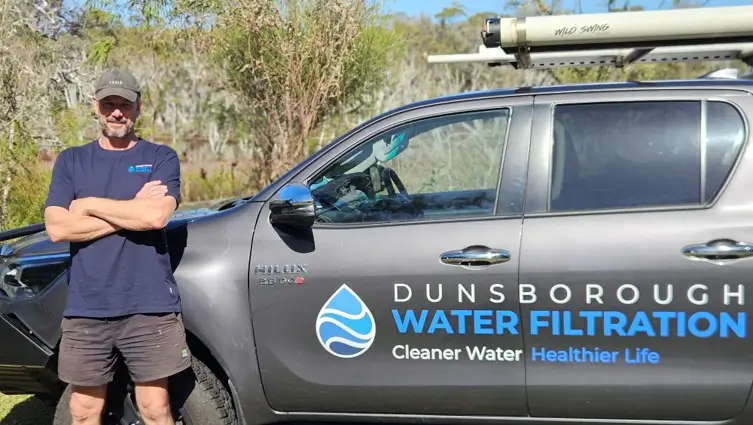
Danny Tuffin is the founder of Dunsborough Water Filtration and a fully licensed WA Plumbing Contractor (PL8180), authorised in Water Supply, Sanitary and Drainage Plumbing.
After building a reputation across the South West through Tuffin Plumbing & Gas for reliable service and straightforward advice, Danny launched Dunsborough Water Filtration to give local families a professional, owner-operated alternative to the big national water filter companies.
He specialises in whole-home Vortex Pro 3 installations and brings hands-on knowledge of the region’s water – from town supplies to rural bores and rainwater tanks – across Dunsborough, Busselton, Yallingup, Margaret River and surrounds.