
Most people in the South West who grew up on tank water have heard it all their lives: rainwater is the purest water there is. It falls from the sky, it hasn’t been through a treatment plant, and it tastes better than anything out of the scheme.
So it caught a lot of attention when a team of environmental chemists from Stockholm University published a paper with a blunt headline: it’s raining PFAS, even in Antarctica and on the Tibetan Plateau, and rainwater is unsafe to drink. And in the plain-English FAQ that accompanied the study, the researchers mentioned one place by name: Western Australia, where, as they put it, “it is common to collect rainwater and drink it without any treatment.”
That’s us. So here’s a straight look at what the study actually found, what’s changed since, and what it means for households from Dunsborough to Margaret River that drink from a tank.
What the Stockholm study found
The paper, Outside the Safe Operating Space of a New Planetary Boundary for Per- and Polyfluoroalkyl Substances (PFAS), was published in August 2022 in the journal Environmental Science & Technology. It was led by Professor Ian Cousins at Stockholm University’s Department of Environmental Science, with co-authors including Professor Martin Scheringer of ETH Zurich.
PFAS are a family of thousands of manufactured chemicals used in firefighting foams, non-stick coatings, waterproofing and industrial processes. Their carbon-fluorine bonds make them extremely persistent, which is why they’ve earned the nickname “forever chemicals.” (If you want the background, our earlier article on PFAS and South West water covers it.)
The researchers reviewed rainwater, surface water and soil measurements from around the world since 2010. Their key findings:
- PFAS is in rain everywhere they looked, including some of the most remote places on the planet, such as Antarctica and the Tibetan Plateau.
- It isn’t going away on its own. Levels of some of the most harmful PFAS in the atmosphere haven’t clearly declined, even though the major manufacturer 3M phased them out around two decades ago. The chemicals cycle between the oceans and the air, partly through sea spray, which keeps returning them to the atmosphere and to land.
- Guideline values have collapsed. The US guideline for PFOA in drinking water dropped by a factor of 37.5 million over 20 years as the health science developed. PFAS have been linked to cancer, reduced fertility, pregnancy complications, raised cholesterol, immune effects and learning and behavioural effects in children.
That last point is the heart of the headline. As Professor Cousins put it: “Based on the latest US guidelines for PFOA in drinking water, rainwater everywhere would be judged unsafe to drink.”
The authors argued that humanity has crossed a “planetary boundary” for PFAS: the chemicals are now so widespread that environmental levels everywhere sit above the most precautionary safety values. And because PFAS are so persistent, Professor Scheringer said, “we can do very little to reduce the PFAS contamination” that is already out there.
What the FAQ says about drinking rainwater
The researchers published a follow-up FAQ answering the questions they were getting from the public and media. A few points stand out for tank owners:
- They named WA. The FAQ notes that drinking untreated rainwater is common in parts of the developing world, and that through media work the authors found it also happens in some developed countries, with Western Australia given as the example.
- They don’t claim rainwater will make you sick. The FAQ says there’s no evidence that drinking water at nanogram-per-litre PFAS levels causes cancer. Guideline values are very low because authorities want to be close to certain that no effects will occur at those levels. The authors are candid that they don’t know whether drinking rainwater is safe, writing: “We have to hope that effects will not occur.”
- Food and dust are the main exposure routes. For most people, PFAS mainly comes from diet and household dust, not water. Drinking water is one route among several, and one of the few you can directly control.
- Activated carbon is the treatment they point to. For rainwater people drink directly, the authors suggest activated carbon filtration could be used, while being honest that they doubt any treatment can reliably get PFAS down to the extreme picogram-per-litre levels in the strictest guidelines, and that most laboratories can’t measure that low to check.
What’s changed since 2022
The Stockholm headline was based on interim US health advisories released in June 2022, which set PFOA at 0.004 nanograms per litre (4 picograms per litre) and PFOS at 0.02 nanograms per litre. Those numbers are so low they’re below what most labs can detect. Here’s what has happened since.
The US set enforceable limits. In April 2024, the US Environmental Protection Agency set the first legally enforceable drinking water limits for PFOA and PFOS at 4 nanograms per litre each, with a health goal of zero. In May 2025, the EPA confirmed it would keep those two limits, while extending the compliance deadline for water utilities to 2031. The enforceable limit is about a thousand times higher than the 2022 advisory, because it’s set at what can be reliably measured and treated, while the health goal still says no amount is ideal.
Australia tightened its guidelines. In June 2025, the National Health and Medical Research Council finalised tougher PFAS values in the Australian Drinking Water Guidelines: 8 ng/L for PFOS, 200 ng/L for PFOA, 30 ng/L for PFHxS and 1,000 ng/L for PFBS. These are stricter than before, but still well above the US figures for PFOA.
Australia now has its own rain data. Until recently, almost all the rainwater measurements in this debate came from the northern hemisphere. In 2026, RMIT University researchers, working with EPA Victoria, published the first Australian study of PFAS in rain, in the journal Environmental Toxicology and Chemistry. They collected rain in Melbourne in 2024 and 2025 and tested for 30 PFAS compounds. They found:
- Eight of the 30 compounds were detected, with total PFAS of about 18 ng/L in the 2024 samples and about 5 ng/L in 2025.
- PFOA and PFOS were below the Australian Drinking Water Guidelines, which the researchers say should reassure people who drink rainwater.
- However, PFOA was above the US EPA lifetime health advisory in both years, and PFOS was above it in 2025.
- Rain from air that had travelled over land carried more PFAS than rain from air that came in off the ocean, suggesting urban and industrial areas are an airborne source.
Lead researcher Professor Oliver Jones made a fair point: “Dose and exposure matter.” Finding a chemical doesn’t automatically mean a health risk. But how reassuring the result is depends on which yardstick you use, and the yardsticks keep getting lower.
Newer, smaller PFAS are building up in rain. A 2026 Lancaster University study in Geophysical Research Letters estimated that around 335,000 tonnes of trifluoroacetic acid (TFA), the smallest and most persistent PFAS, fell to Earth from the atmosphere between 2000 and 2022, mostly formed from refrigerant gases that replaced CFCs. Deposition may keep increasing for decades. Health agencies currently consider environmental TFA levels to be below harmful thresholds, but it’s a reminder that “PFAS in rain” isn’t a one-off story.
What this means in the South West
Here’s where we want to be careful, because it would be easy to overstate this.
There’s no published PFAS-in-rain data for the South West yet. The Melbourne study is the only Australian rain study so far, and it found levels below our national guidelines. The finding that air coming in off the ocean carries less PFAS than air from over land is interesting for us: much of our winter rain arrives on fronts off the Indian and Southern Oceans, away from major cities. That’s a reasonable reason to expect our rain may be at the cleaner end, but it hasn’t been measured, so it’s not something anyone can promise.
What’s on your roof matters as much as what’s in the sky. Rain is only the starting point. Tank water picks up whatever is on the roof, in the gutters and in the tank itself. PFAS contamination in Australia is concentrated around places where firefighting foams were used heavily, such as airports, Defence bases and fire training grounds, and there is a known PFAS site in Busselton that local authorities are monitoring. If you’re near a known contaminated site, it’s worth checking with the Department of Water and Environmental Regulation or getting your tank water tested.
Nobody is testing your tank for you. Scheme water is tested constantly: Busselton Water’s 2023-24 program ran more than 1,500 PFAS analyses and found none in its supply, and the Water Corporation, which supplies Dunsborough, Yallingup and Margaret River, publishes its own annual water quality reporting. Tank water has no such checks. As we covered in who tests your tank or bore water, on a tank you’re effectively your own water utility.
PFAS isn’t the biggest risk in most tanks. Healthy WA’s advice is that rural rainwater is usually safe to drink if the tank and roof are properly maintained. The more common, more immediate problem is bacteria from birds, possums and debris. That’s why we wrote about E. coli in rainwater tanks. PFAS is a long-term, low-level exposure question. Microbial contamination can make you sick next week.
Practical steps for tank owners
- Maintain the basics. Keep gutters and the roof clean, trim overhanging branches, screen inlets and overflows, and fit a first flush diverter so the dirtiest runoff after a dry spell doesn’t go into the tank. Have the tank inspected and desludged every few years.
- Think about your location. If you’re near an airport, fire training ground or known contaminated site, get advice before relying on tank water for drinking.
- Test with a proper lab if you want to know. PFAS testing needs a specialist laboratory; look for one that is NATA-accredited for PFAS analysis, and compare results against the Australian Drinking Water Guidelines.
- Put a barrier between the tank and the tap. If your household drinks rainwater, a properly specified whole-home system gives you one. For tank and bore supplies we install the Ultra V Pro 3, which pairs sediment filtration and an activated carbon stage (the treatment the Stockholm researchers point to for PFAS) with UV sterilisation for bacteria and other microbes. No filter can promise results at picogram levels, and we won’t either, but it’s a meaningful extra layer on water that otherwise gets no treatment at all.
If you already have a whole-home filter from another supplier, we can service it and replace the cartridges too.
The bottom line
The Stockholm study’s headline was designed to make the world pay attention, and it worked. The core message holds up: PFAS is now in rain everywhere, it isn’t going away, and safety guidelines keep moving lower as the science develops. The researchers named WA’s habit of drinking untreated rainwater for a reason.
The newer evidence adds some balance. The first Australian rain study found levels below our national guidelines, and there’s good reason to think South West rain may be on the cleaner end. But “below the current guideline” is a moving target, and on a tank, nobody else is watching your water for you.
If your family drinks from a tank, the sensible approach isn’t panic. It’s a well-maintained tank and roof, and a proper barrier between the tank and your tap.
Want to talk it through? Call Danny on 0452 259 399 or request a quote for honest advice from a licensed WA plumbing contractor (PL8180), across Dunsborough, Busselton, Yallingup, Margaret River and surrounds.
Sources:
- Stockholm University, “It’s raining PFAS: even in Antarctica and on the Tibetan Plateau rainwater is unsafe to drink”, 19 August 2022.
- Cousins I.T. et al., “Outside the Safe Operating Space of a New Planetary Boundary for Per- and Polyfluoroalkyl Substances (PFAS)”, Environmental Science & Technology, 2022.
- Stockholm University, FAQ on the PFAS planetary boundary study.
- Singh N., Askeland M., Utembe S., Coggan T., Jones O., “Concentrations of Per- and Polyfluoroalkyl Substances in the Rainwater of South-Eastern Australia”, Environmental Toxicology and Chemistry, 2026; and RMIT University, “First-ever Aussie study of ‘forever chemicals’ in rain”, September 2026.
- Hart L. et al., Geophysical Research Letters, 2026 (TFA deposition), via ScienceDaily.
- US EPA PFAS National Primary Drinking Water Regulation (April 2024) and May 2025 announcement.
- NHMRC, Australian Drinking Water Guidelines PFAS update, June 2025.
- Healthy WA, Water tanks on your property.
- Busselton Water, Annual Water Quality Report 2023-24.
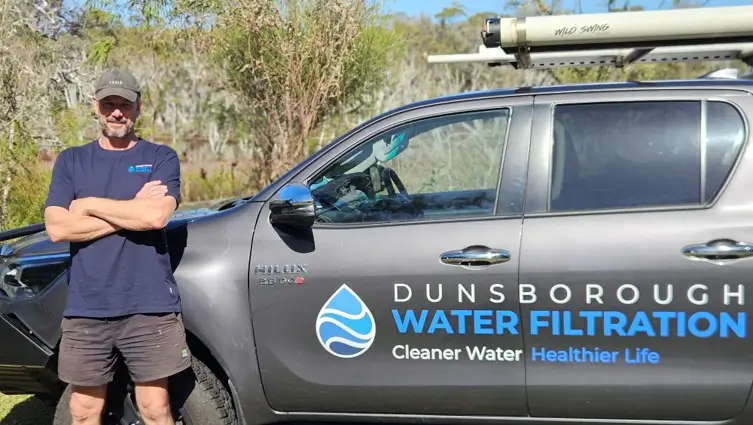
Danny Tuffin is the founder of Dunsborough Water Filtration and a licensed WA Plumbing Contractor (PL8180). A South West local with years of hands-on plumbing experience through Tuffin Plumbing & Gas, Danny specialises in whole-home water filtration for town, bore and rainwater supplies, installed properly, with honest advice, from Dunsborough to Margaret River.
On this page
About the Author: Danny Tuffin
Danny Tuffin is the founder of Dunsborough Water Filtration and a fully licensed WA Plumbing Contractor (PL8180), authorised in Water Supply, Sanitary and Drainage Plumbing.
After building a reputation across the South West through Tuffin Plumbing & Gas for reliable service and straightforward advice, Danny launched Dunsborough Water Filtration to give local families a professional, owner-operated alternative to the big national water filter companies.
He specialises in whole-home Vortex Pro 3 installations and brings hands-on knowledge of the region’s water – from town supplies to rural bores and rainwater tanks – across Dunsborough, Busselton, Yallingup, Margaret River and surrounds.