
A Guide for South West WA Homes
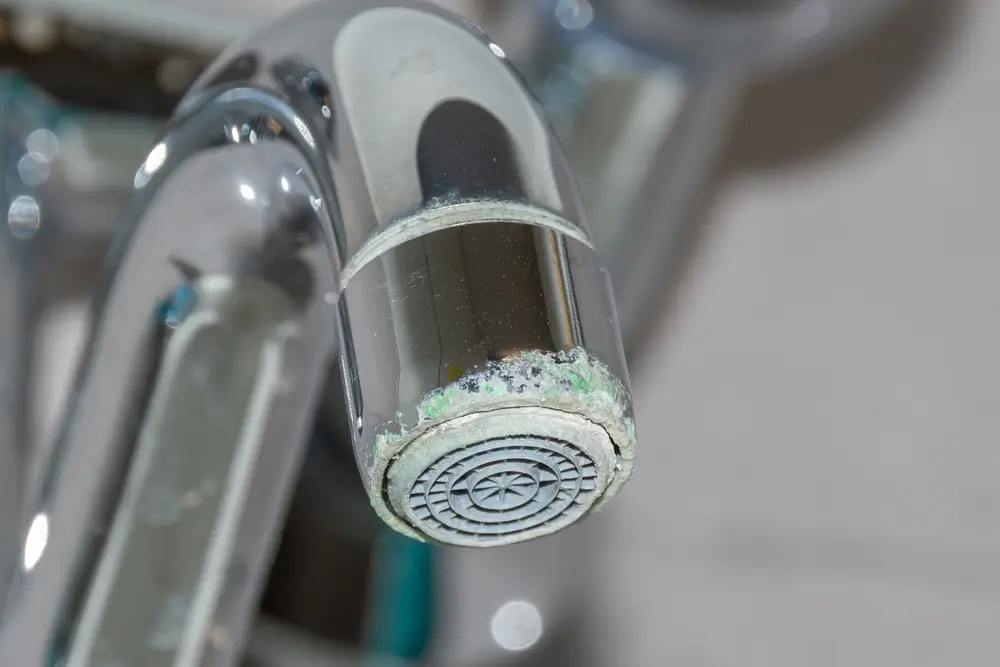
If you live in the South West, you’ve probably seen the signs. White crust around your tap spouts. Cloudy spots on the shower screen that come back no matter how often you clean. A kettle that’s developed a chalky lining, and a hot water system that seems to be working harder every year.
That’s hard water – and around here, it comes with the territory. For decades, the standard fix was a salt-based water softener: a bulky tank in the garage, bags of salt on the shopping list, and salty brine flushed down the drain every regeneration cycle.
The good news? That’s no longer the only way – and for most South West homes, it’s no longer the best way. This guide explains what hard water actually is, why traditional softeners are falling out of favour, and how modern salt-free scale control gives you the results you want without the drawbacks.
Why the South West has hard water
Water hardness is simply a measure of dissolved calcium and magnesium minerals. Water picks these up as it moves through soil and rock – which is why groundwater supplies are almost always harder than water from dams or rainfall.
That matters here, because much of the South West drinks groundwater – and not all of it comes from the same place. Busselton’s scheme water is supplied by Busselton Water, drawn largely from the ancient Yarragadee aquifer, and the utility’s latest annual reporting shows hardness in its network reaching up to 150 mg/L of calcium carbonate – comfortably within the Australian Drinking Water Guidelines, but firmly in “hard” territory where scale becomes a fact of life. Dunsborough is different: the town is supplied by the Water Corporation from the Quindalup wellfield just south-east of town, and its latest published figures put hardness at 74 to 88 mg/L – noticeably softer than Busselton’s, but still moderately hard, and still enough to leave its mark on a hot water element over the years. (Busselton Water also sells bulk water to the Water Corporation to top up the Dunsborough supply, which is why locals often mix the two up.)
And if your property runs on bore water, you can be dealing with considerably higher hardness again – bores in this region vary enormously from one property to the next, which is why a proper water test is always the right starting point.
To be clear: hard water isn’t a health problem. Calcium and magnesium are minerals your body actually uses. The problem is what they do to your house.
What scale is really costing you
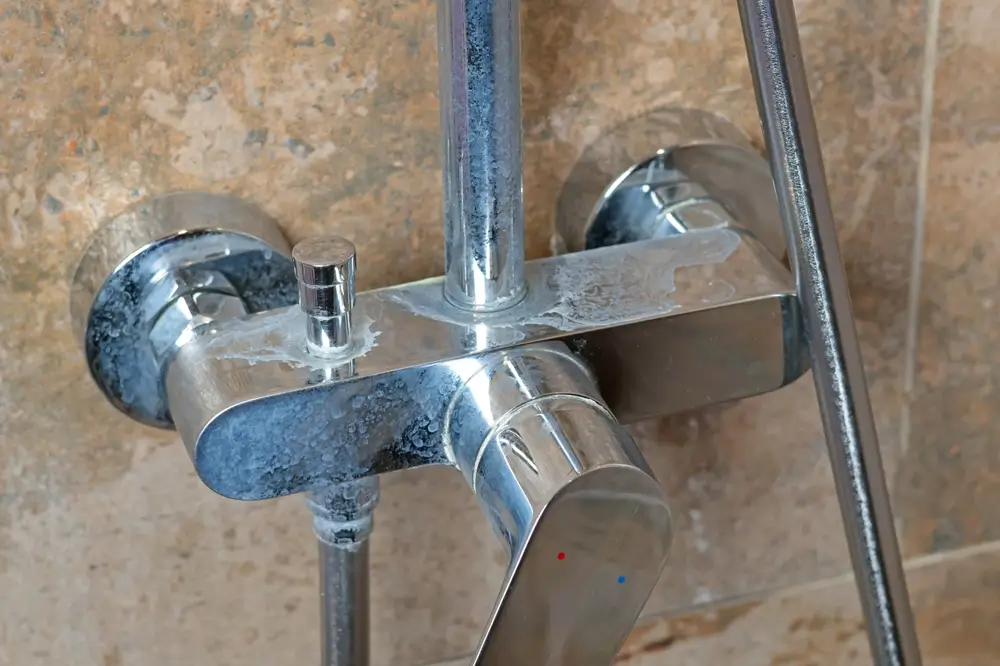
When hard water is heated or evaporates, those dissolved minerals come out of solution and bond to surfaces as limescale. Around the home, that means:
- Hot water systems – scale builds up on heating elements and heat exchangers, forcing the system to use more energy and shortening its life. This is usually the most expensive casualty of hard water.
- Appliances – dishwashers, washing machines, coffee machines and kettles all accumulate scale, clog, and fail earlier than they should.
- Fixtures and glass – crusty tap aerators, spotted shower screens, and stained tiles that need constant scrubbing.
- Soap performance – hard water fights your soap and detergent, so you use more of everything to get the same lather.
None of it happens overnight, which is exactly why it’s easy to ignore – right up until the hot water system needs replacing years ahead of schedule.
The traditional answer: salt-based softeners (and their problems)
A conventional water softener works by ion exchange: it strips calcium and magnesium out of the water and swaps them for sodium, then periodically flushes the collected minerals down the drain in a salty brine solution.
It does prevent scale. But it comes with a long list of trade-offs that explain why salt softeners are increasingly being restricted or phased out in many parts of the world:
- Salty brine discharge. Every regeneration cycle sends concentrated salt water into the wastewater system – an environmental problem that regulators are paying closer attention to.
- Wasted water. Regeneration and backwashing can waste hundreds of litres every month.
- Added sodium. Softened water carries extra sodium – not ideal for everyone, and many people simply don’t like drinking it.
- That “slippery” feel. Stripping the minerals changes the water. Plenty of people find salt-softened water feels slick or “silky” in the shower and tastes flat.
- Ongoing cost and hassle. Bags of salt, valve servicing, resin issues, a brine tank to clean, and a controller that needs power and programming.
- Space. A softener plus brine tank takes up serious room in a garage or plant area.
There’s also a quieter downside: a softener removes the very minerals that make water taste good and contribute to its natural balance. You solve the scale problem by taking something away – then live with what’s left.
The modern alternative: stop scale without removing the minerals
Here’s the shift in thinking. You don’t actually need to remove calcium and magnesium to protect your home – you need to stop them sticking to things.
That’s what advanced anti-scale media does. The technology is called DAC – Direct Anti-Scale Crystallisation, a refined form of template-assisted crystallisation. Instead of stripping minerals out, the media acts as a microscopic template that hardness minerals briefly attach to. In that short contact time, the calcium and magnesium are converted into tiny, stable crystals. Once formed, these micro-crystals stay suspended in the water and can no longer bond to metal surfaces, heating elements, pipes or fixtures – they simply pass through the system and down the drain in normal use.
The practical result:
- No salt, no brine, no chemicals – it’s a physical transformation, not chemical dosing.
- No power and no backwashing – the media is purely flow-driven, so there’s nothing to program and no water wasted.
- Minerals stay in your water – it still tastes like natural, mineral-rich water, with none of the slimy softened feel and no added sodium.
- Whole-home protection – hot water systems, appliances, shower screens and fixtures all see far less scale build-up.
- Set-and-forget maintenance – it’s a cartridge, not a plant room. No salt runs, no valve servicing, no brine tank.
This is why salt-free scale control is widely regarded as the future of water treatment for homes: high performance, low waste, and environmentally responsible.
Putting it all together: the Vortex Pro 3 + DuraScale-X™
Scale is only one part of the water picture. Chlorine, sediment, taste and odour, heavy metals and PFAS (“forever chemicals”) matter just as much – and a softener does nothing about any of them.
That’s why our recommended setup for South West homes on scheme water is the Vortex Pro 3 whole-home filtration system fitted with the DuraScale-X™ filter pack. It’s a three-stage system installed at the point of entry, so every tap, shower and appliance in the house is protected:
- Stage one captures sediment, rust and particulates before they reach the finer filters.
- Stage two targets chlorine, taste and odour, heavy metals and PFAS – the things that make water unpleasant (or worse).
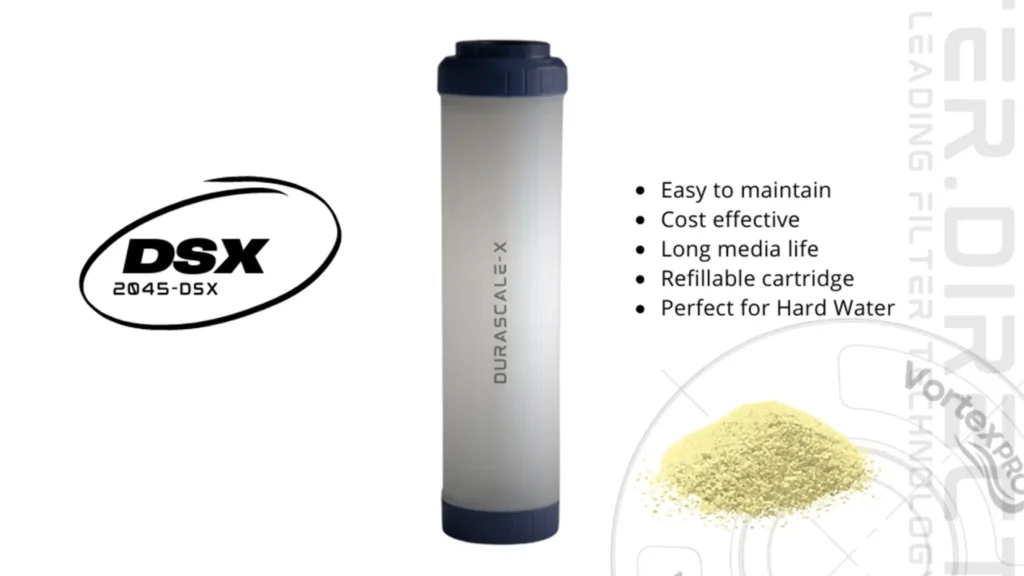
- Stage three – DuraScale-X™ – delivers the salt-free scale protection, using DAC media engineered specifically for Australia’s hard water conditions and handling hardness levels well beyond what South West scheme water throws at it.
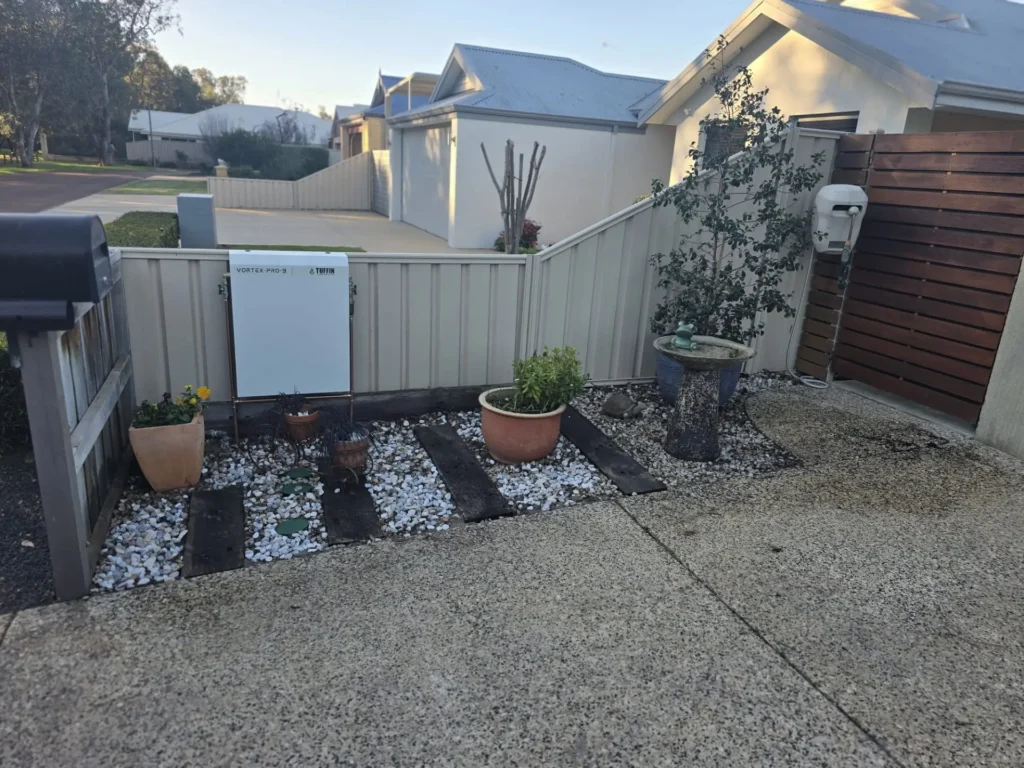
Compared with a traditional softener, the whole thing lives in a compact stainless steel unit – no brine tank, no drain line, no power point required – backed by a 10-year warranty. The DuraScale-X™ media itself is long-lived, typically lasting one to three years in a standard cartridge, so ongoing maintenance is just routine filter changes.
The end result is water that’s clean, great-tasting, still rich in natural minerals – and gentle on every appliance and fixture in your home.
Which homes is this right for?
Salt-free scale control with a Vortex Pro 3 is ideal for family homes on scheme water in Dunsborough, Busselton, Vasse, Yallingup, Cowaramup, Margaret River and surrounds – especially new builds, renovations, and anyone replacing a hot water system who’d rather not do it again early. It’s also a great fit for coffee lovers protecting an espresso machine, and anyone who wants softer-behaving water without drinking added sodium. And because Busselton’s supply runs harder than Dunsborough’s, homes in Busselton, Vasse and Wonnerup have even more to gain from scale protection.
On bore or tank water? get in touch, our Ultra V Pro 3 can help – but bore water chemistry varies so much across the region that we’d always start with a water quality test and tailor the system to your property.
The bottom line
You don’t need a salt-guzzling softener to beat scale in the South West. A Vortex Pro 3 paired with the DuraScale-X™ filter pack protects your hot water system, appliances and fixtures from scale while also removing chlorine, sediment, PFAS and heavy metals – with no salt, no brine discharge, no wasted water, no power, and all the natural minerals left in.
It’s everything a water softener promised, without everything it made you put up with.
Not sure how hard your water is? We’re local, and we test water across the South West every week. Give Danny a call on 0452 259 399 or request a quote – honest advice from a licensed WA plumbing contractor, tailored to your home.
Dunsborough Water Filtration supplies, installs and maintains whole-home water filtration systems across Dunsborough, Busselton, Yallingup, Margaret River and the South West. Licensed WA Plumbing Contractor PL8180.
On this page

About the Author: Danny Tuffin
Danny Tuffin is the founder of Dunsborough Water Filtration and a fully licensed WA Plumbing Contractor (PL8180), authorised in Water Supply, Sanitary and Drainage Plumbing.
After building a reputation across the South West through Tuffin Plumbing & Gas for reliable service and straightforward advice, Danny launched Dunsborough Water Filtration to give local families a professional, owner-operated alternative to the big national water filter companies.
He specialises in whole-home Vortex Pro 3 installations and brings hands-on knowledge of the region’s water – from town supplies to rural bores and rainwater tanks – across Dunsborough, Busselton, Yallingup, Margaret River and surrounds.